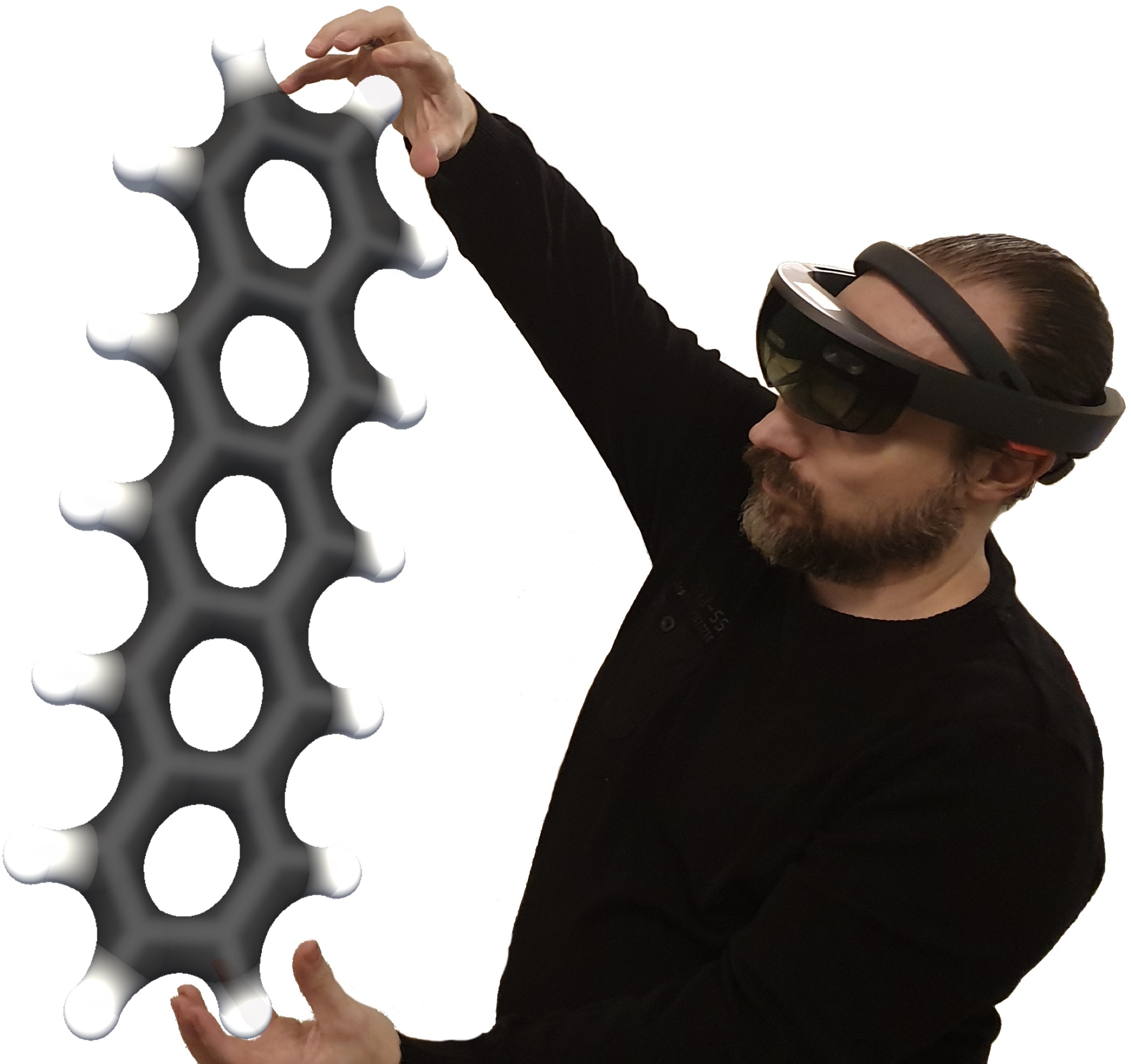
There is now a YouTube channel with movies related to research described at this website. You can visit my YouTube channel here! Welcome ! This site is about recent research in computational chemistry. My main focus is the development of a novel interactive approach to molecular modeling, taking advantage of recent progress in the field of virtual reality combined with HPC. This project is described here: FVNano project. Another area where the above method as well as more familiar ones can be applied concerns the investigation of large conformational changes and mechanical properties of macromolecules. PNAS early view of March 2010 features a one microsecond molecular dynamics simulation of the pentameric ligand-gated ion channel GLIC. The free open access article is available here, and here is a short movie. (Nury et al., PNAS, 2010, early view) Previously, we made it to the 2009 January issue of Nature, where the crystal structure of an open form of GLIC was described. We used additional molecular dynamics simulations to characterize this state. Here is a link to the Nature website, and here is a short movie. There is also a press release. (Bocquet et al., Nature, 457, 2009, 111-114) The projects are listed below. Click on the logo for more information about a particular project. Support comes from the European Union, funding agencies, supercomputer centers and companies. FVNano: towards a virtual laboratory for biomolecular simuations and materials science. MDDriver: Driving Molecular Dynamics codes by coupling with a CPU intensive visualization module. SNARE/DECI: SNARE mediated membrane fusion, DEISA Extreme Computing Initiative. FonFlon: “Relation fonction/fluctuation chez les proteines”. About the link between biological function and fluctuations for proteins. While I was an EC Research fellow at Oxford University, I worked on computational studies of the bacterial transporter protein FepA in membranes (Marie Curie Fellowship MCFI-2000-01210). This project is related to J. D. Faraldo-Gómez's work on the ferric hydroxamate receptor A (FhuA). The simulations were extended to other outer membrane proteins of beta-barrel shape, in particular the enzymes OmPLA and OmpT. On a broader level methodological aspects such as simulation convergence were studied in collaboration with a number of colleagues. Keywords: anti-bacterial drugs, transport proteins, molecular modelling I started working on biological systems in Mark SP Sansom's group at the Laboratory of Molecular Biophysics, University of Oxford, where I was a postdoctoral fellow during the years 2001 and 2002. Currently I am a researcher ("Chargé de recherche de 1ère classe") working in Paris at the Institut de Biologie Physico-Chimique. My work is carried out in Philippe Derreumaux's group in the "Laboratoire de Biochimie Théorique" of the CNRS (UPR9080). | |||